While the Argentine tango singer Roberto Emilio Goyeneche was nicknamed ‘El Polaco’ (‘the Pole’) for his blond hair and thinness like Polish immigrants of the time, he was actually of Basque descent. He is considered to have epitomised the bohemian life of 1950s Buenos Aires.
Goyeneche was born on 29 January 1926 in the neighbourhood of Saavedra in Buenos Aires. His career in music began in 1944, when he was 18 years old. After winning a local contest, Goyeneche joined the orchestra of Raul Kaplun. His debut performance was broadcast on Radio Belgrano. He then went on to sing with Angel Diaz for Horacio Salgan’s orchestra. It was Diaz who gave Goyeneche the nickname ‘El Polaco.’
In 1956, Anibal Troilo, a dear friend and a bandleader with an eye for talent, hired Goyeneche to join his orchestra. Together, they recorded 26 songs. In 1963 he started his solo career, which had the highlight of Goyeneche being the first singer to record Astor Piazzolla’s ‘Balada Para un Loco’ (‘Ballad for the Crazy One’). He continued to sing under other great maestros of the time, such as Armando Pontier, Raúl Garello, Atilio Stampone, Baffa-Berlingieri and many others. Goyeneche later reunited with Troilo to record two LPs, ‘El Polaco y yo’ (‘The Pole and I’) and ‘¿Te acordás Polaco?’ (‘Do You Remember Polish?’)
Goyeneche had the reputation of being a singer like no other. His diction was deemed perfect, even in the later years of his life. He was expressive in his phrasing and added particular details to his recordings and performances which made him a unique vocalist. He had his way of handling accents and silence, he delayed some words of the lyrics, he would intimately whisper a line–all of which made him exceptional and easily recognisable.

Goyeneche was also considered a singer who was a respectful interpreter of the tango rhythm during a period when soloists mixed with ballads or other sophisticated songs with a tango influence. He recorded hits like ‘El Motivo’ (‘The Motive’), ‘La última curda’ (‘The Final Curse’), ‘Naranjo en Flor’ (‘Orange Blossom’), ‘Qué Solo Estoy’ (‘How Lonely I Am’), ‘Lejana Tierra Mía’ (‘Far Away From My Land’), ‘Volvió una Noche’ (‘He Returned One Night’), ‘Pompas de Jabón’ (‘Soap Bubbles’), ‘Afiches’ (‘Posters’), ‘Maquillaje’ (‘Makeup’), ‘Malena,’ ‘Soy un arlequín’ (‘I’m A Harlequin’), ‘Maria,’ ‘Garua’ (‘Drizzle’), ‘Cuando Tallan los Recuerdos’ (‘When They Carve Memories’), and ‘Ya Vuelvo’ (‘I’ll Be Right Back’).
He toured internationally, with notable performances like singing in the ‘Tango Argentino’ at City Centre in 1985 and in Paris in 1987.
Even in the 1980s, Goyeneche was still an active performer, appearing as a special guest in movies like ‘El Exilio de Gardel’ (‘The Exile of Gardel’) and ‘Sur’ (‘South’) directed by Fernando Solanas.
Goyeneche died of kidney and heart failure on 27 August 1994 in Buenos Aires. He is considered one of the greatest tango singers of all time. He made more than 100 records over his 40-year career. An avenue of his childhood neighbourhood of Saavedra is named after him.


During these years, however, Rivero evidently didn’t last long in orchestras. He would claim that his deep voice–unconventional then–was something of a severe handicap. It was in the 1950s when he hit his stride as a singer and started his career as a soloist. In the 1960s, he was accompanied by another guitar group of Rafael Del Pino, Héctor Davis, Héctor Barceló, Rubén Morán and Domingo Laine. During a period in tango when orchestra dominated, a guitar-only accompaniment was considered a bold statement by Rivero and this associated him with the aura of the countryside.
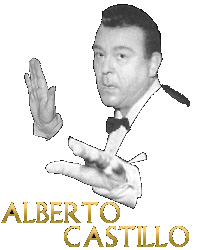
At 15, fate struck when he was singing for his friends and the guitarist Armando Neira heard him. Neira added the young Alberto to his band, marking the young man’s professional debut under the name of Alberto Dual (and occasionally, Carlos Duval). Castillo went on to sing with the orchestras of Julio De Caro in 1934, Augusto Berto in 1935 and Mariano Rodas in 1937.
“Por una Cabeza” is an easy song to dance tango to because of its slow and clear rhythm. Because of this, it become one of the most popular songs played by almost all of the major orchestras during the 1940’s and 50’s.