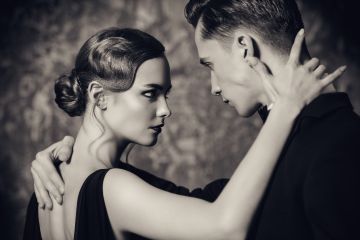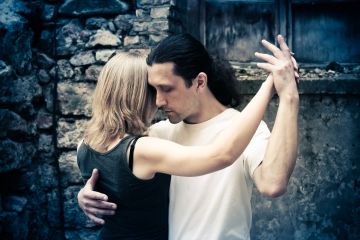
Tango is a dance to some and an art form to
others. The exact origins of tango, both the word and the dance, are ambiguous
and are lost in myth and unrecorded history. The generally accepted theory is
that in the mid-1800s, the African slaves who had been brought to Argentina and
Uruguay began to influence the local culture. In 1889, the Real Academia
Espanola dictionary defined the word “tango” as a “popular celebration and
dancing of black people in America.” The expression of “toca tango” or “tocatambo”
in the Bozal dialect (Portuguese Spanish spoken by African slaves) means to
play the drum, or to start the dance, or the meeting space.
It took almost 100 years for the dictionary
to redefine tango as a “world-wide known Argentinian dance for two people who
join in movement, based on a binary 2/4 beat”. Not only has the meaning of the
word tango changed, but the music has transformed also from being played on
portable instruments such as the flute, guitar and violin into a full concert
with a big orchestra. The dance has also been transformed from being in a close
embrace, almost fastened together to more open flowing styles of today.
On August 31, 2009, UNESCO approved a
joint, proposal by Argentina and Uruguay to include the tango to the UNESCO
Intangible Cultural Heritage Lists.
MID 1800s:
In 1870-1880 both Argentina and Uruguay saw
an influx of millions of European immigrants. Most immigrants were penniless
single men hoping to make their fortunes working the land, but ended up in the
cities. In Montevideo in Uruguay, public dances were held in warehouses for the
lower class and prostitutes were paid to dance. They danced a range of music
from habanera, polka, mazurka and waltzes but in the “corte and quebrada” way,
i.e. a tight embrace where they would stop and pose for a beat or two and then
continue. From this mixing pot of cultures and candombe rhythms the street
dances of the Montevidean milonga developed into now-called Argentine Tango.
Improvisation was a key element of the dance which still remains today, unlike
the percussion instruments which were gradually lost and replaced by the
bandoneon. The bandoneon being the most recognizable tango instrument, with its
deep melancholic feeling, reflecting the profound sense of loss and longing for
the people in destitute times with nothing to their name except macho pride and
desperation.
1908:
THE
GRANDEUR: May 25, 1908 the Colon Theater opened its
doors and wowed the crowds becoming one of the world’s top opera venues. Buenos
Aires, a multicultural city competed with major European capitals for grandeur
and refinement as the public was eager for arts and culture. Tango began to
raise its profile by entering theatres, cafés and the upper-class brothels.
Opening of Academia’s (places where you could learn many dances including
tango) contributed to tango’s popularity. The typical bandoneon, violin and
piano, were replaced by a sextet two bandoneons, two violins, piano and double bass,
as it provided richer and more sophisticated orchestrations.
1910:
TANGO
FOR EXPORT: Tango was then exported around the
world by traveling poets, dancers and musicians. There were no recording
studios in South America, so many orchestras traveled to Paris to record their
music. Over a third of the 1,000 gramophone records released were of tango
music and tango sheet music was also sold in large quantities. The sons of
South American society families such as Ricardo Guiralde (major Argentine
writer) had made their way to Paris. They introduced the tango into a society
eager for innovation, which was not entirely averse to the risque nature of
this import, especially taught by the dashing, rich South American men. Tango
became a craze in Paris: tango music, tango lessons, tango dance, tango teas,
tango train excursions, tango everything. In 1913 Tango had spread from St
Petersburg to New York, and become an international phenomenon. The South
American upper classes who had shunned the tango were now forced into embracing
it, because it was fashionable in Europe.
1920:
TANGO
IN MOVIES: Dancing had always been recorded in
films, such as the highly dramatic Apache dance associated with Parisian street
culture (1903), or the glamourised Hollywood tango of Rudolph Valentino, as the
most famous if not completely inauthentic tangoing gaucho in the movie “The
Four Horsemen of the Apocalypse”(1921). There are recordings of tango as an
everyday socialisation, a romantic dance to seduce or a competition to show off
and to be watched compared to being danced. These examples highlight the
conflict that “Art” which represents a non-authentic portrayal of the dance,
has over time influenced or created a stereotype for tango: tango being the
dance of thugs and prostitutes; or you must dance it with a rose in your mouth.
Although movies have helped make tango popular, they have also created false
impression of the dance and many tanguero’s would argue that the tango in the
movies or even on stage, is not tango at all.
1930:
THE
VOICE: Carlos Gardel became the champion of the
authentic tango with his beautiful voice and macho looks as a popular singer
and movie star. His fame spread worldwide with the help of the invention and
wide use of radio, records and film.
1935:
THE
CRASH OF TANGO: Tango was now out of fashion in
Europe, a military coup in Argentina led by the pro-fascist general suppressed
and censored it for 10 years, and Gardel had died in a plane crash in 1935.
South America was also devastated by the Great Depression after the Wall Street
Crash, which also changed the character of tango again, where the lyrics
reflected the renewed poverty and social divisions.
1940:
THE
GOLDEN AGE OF TANGO: Argentina and Uruguay were
able to stay neutral for the majority of WW2 and became very wealthy due to
trade. Music, poetry and culture flourished and by the mid to late 1940s, tango
was at its height. There were more than 50 orchestras and ensembles playing
around the city at salons, cafés, cabarets and social clubs. The demand of
producing so much live music, created the competition between musicians to
strive thus creating so many legendary tango musicians, conductors and
composers. The best tango orchestras would be booked for more than a year in
advance. Those were the years of the great dance balls, with countless tango
radio shows and hundreds of big bands with popular singers. The dancers created
a style that was elegant, sleek, choreographically complex, and mysterious.
Tango became a matter of national pride under the government of Argentina’s
President Juan Peron, in his first term (1946-1955).
1950:
THE
REPRESSION ERA: Tango has always reflected the
economic condition of the time. You can hear it in the music in poorer times —
orchestras were smaller, and lyrics ranged from poetic, subversive or ‘corrupt’
language of the lunfardo slang or politically censored. The dance and its music
went underground as large dance venues were closed as public gatherings in
general were prohibited. The tango was repressed by post-Peronist nationalist
government and only survived in smaller, unpublicised venues and in the hearts
of the people. At the end of the 1950s tango eventually went out of fashion,
crushed like many other dances, by the arrival of American swing and
rock-n-roll, and from the 1960s to the 1980s, was only danced and played by a few
of the older generation enthusiasts.
1975:
ASTOR
PIAZZOLIA had the vision of tango “for the ear
rather than the feet”. He created numerous operas, concertos, theatre and film
scores. In 1975 he set up his Electronic Octet an octet made up of bandoneon,
electric piano and/or acoustic piano, organ, guitar, electric bass, drums,
synthesizer and violin, which was later replaced by a Flute or saxophone.
Piazzolla produced innovative works and interpretations which broke away from
the original mold of an “orquesta tipica” and created chamber music instead,
music without a singer or any dancers. He achieved world acclaim by combining a
wide range of styles from Jazz, Rock, Electronic and Tango, however, he
generated hatred and criticism among the orthodox tanguero’s.
1980:
CULTURAL
REVIVAL. With the return of Argentina to democracy
in 1983, a new generation launched themselves on a cultural revival –
recovering the almost forgotten tango. Luckily, the elder tanguero’s and
musicians of the 1940’s were still alive and were a great source of knowledge.
This revival spurred the worldwide touring of tango troupes starring dancers
such as iconic Juan Carlos Copes. They created a dazzling romanticisation of
tango of the golden age. One of the most influential teachers of the 90’s was
Antonio Todaro. He transformed tango beyond simple steps into an intellectual
challenge that encouraged new dancers. In Todaro’s tango, instead of just
walking, both the man and the woman have important roles to play using figurers
and styling to showcase tango to its best. This development of new figurers,
was stimulated by the creation of new orchestras, as Todaro felt the need to
invent new movement to match the music instead of just dancing how it was. He
also taught many of the professional stage dancers, and toured frequently in
Europe —Todaro’s protégé, Miguel Zotto, become one of the greatest stage
performer of this generation.
1990:
NOT
SO NUEVO: In the late 1990’s, the Tango Nuevo
movement emerged in Buenos Aires. It was spear-headed by Gustavo Naveira &
Fabian Salas, who applied the principles of dance kinesiology from modern dance
to analyze the physics of movement in Argentine tango. Taking what they learned
from this analysis, they began to explore all the possibilities of movement
within the framework of Argentine Tango. As a result, the work of these
Founders of the Tango Nuevo movement brought about a shift from teaching what
to dance toward teaching how to dance.
2000:
FUSION: Contemporary Tango (electronic) – Paris-based group Gotan (Lunfardo
wordplay on ‘Tango’) Project was one of the first to renew the sound of tango
(again) by adding electronic elements to tango dance music around the year
2000, and since then many other groups have followed suit by making both subtle
or prominent changes to traditional tango. This evolved into the fusion with
contemporary non-tango music and other dance genres. Although more young and
adventurous people are attracted to the world of tango by the prospect of
dancing to modern music, such as the electronic beats of Carlos Libedinsky’s
Narcotango, or complete non-tangos, such as jazz and pop, it is still not as
popular as traditional tango.
NOW:
Today, tango is danced around the world: from Montevideo to Berlin to almost every city in the world. This is reflected not only by the number of annual international tango festivals which are supported by professional instructors on a global circuit, but by the quality of dancers throughout the world.
THE FUTURE:
Like any art form, no-one knows what is
next in the evolution of tango. We will just have to wait and see…